Moonlight Sonata, by Beethoven
Keylight lights every key as the music plays, a few bars at a time. The first 100 pianists get it free, for life.
places left · until 4 January
No card, nothing to pay, ever. The practice rooms are free forever. The score opens with no sign-up.
How to learn Moonlight Sonata
- Hear it through at Slow (22 bpm). Open it in the reader, choose Slow, and follow the page with your eyes without playing.
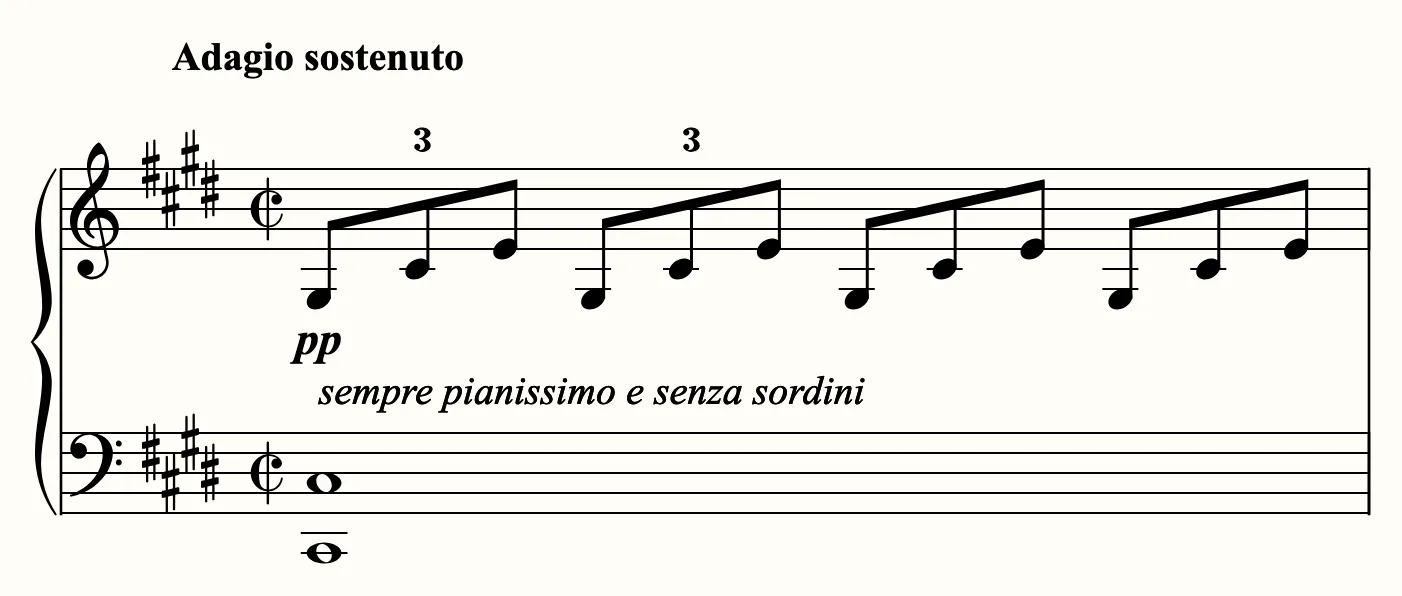
- Learn the right hand of bars 1 to 8 on its own, in C♯ minor. Say the note names out loud the first time through, then play it three times without stopping.
- Find the chords under it: C♯m, C♯m7, F♯m7 and G♯7. Play each one as a block in your left hand and say its name, so you know what the harmony is before the left hand has to move.
- Learn the left hand of the same bars on its own. Keep it quiet and even: it is the floor the tune stands on.
- Put hands together at Slow, 22 bpm. Bars 1 to 8 only. Stop after every wrong note and play that bar again before moving on.
- Move up to Steady (33 bpm) once Slow feels easy three times in a row. Then learn the next 8 bars the same way: right hand, left hand, together.
- Play the whole piece (about 6 minutes) from the start, at whatever speed keeps it going. A steady run with a few slips beats a fast one that stops.
About this piece
Beethoven called it a fantasy; a critic later said the rippling triplets looked like moonlight on Lake Lucerne, and the name stuck. Underneath the calm surface it is a funeral march: the same slow tread, dressed in arpeggios.
How to play it
Keep the triplets absolutely even and almost silent, and let the dotted melody above them toll like a distant bell.
Reading it, and printing it
The score opens in Artform's reader, which shows the music as engraved notation and plays it back so you can hear the line before you try it. You can slow the tempo down, loop a passage that is not working yet, and print the page when you would rather have paper on the stand.
The file itself is MusicXML, which MuseScore, Sibelius, Finale and Dorico all open, so the notes are yours to keep whatever you read them in.
Need it in another key? Transpose it: pick the key, see the score move, then print it or take the file.
Teaching it?
Send it to a class in one step. Your students open the score, hear it, and play along at their own speed: free, with no sign-up.
Want to set it as this week's work and see each student's practice? Artform for teachers is free too.
More free Beethoven sheet music
Where else this one is listed
The same piece, in the lists people search for.
Who Beethoven was
German composer who bridged the Classical and Romantic eras and, in doing so, changed what a composer was even allowed to be: not a court employee but an artist answerable to no one. He began losing his hearing in his twenties, confessed his despair in a private letter never sent in his lifetime, then kept composing for another quarter century, eventually conducting a premiere he could not hear at all, needing to be turned around to see the audience applauding behind him. His nine symphonies, thirty-two piano sonatas, and chamber works move from Classical poise to a defiant, personal intensity no one had written before. He remains, by most measures, the most performed composer on any concert…
Learn the music behind it
Reading a piece and understanding it are different skills. If you want the harmony under this one, the chord trainer teaches chords the way songs use them, and the scale pages cover the fingering for every key, including C♯ minor.
Around this piece: The C♯ minor scale, with fingering · How a minor key is built · Moonlight Sonata in the history of the piano