Chapter VII · Iron and steel · 1843–1900
How the modern piano was built
The modern piano is built, and a piano arrives in every home.
Painting: Clive Douglas, Ancient desert
Every section is read aloud: press Listen. Or hear the whole chapter in the app, where you can tick off each part as you go.
In this chapter: 1843 The iron frame · 1853 Steinway · 1865 A piano in every parlour · 1880s Eighty-eight keys · 1887 Across the world
1843
The iron frame
A harp of iron
As composers asked for more power, makers used thicker strings pulled tighter. The strings of a modern piano pull on its frame with a force of around twenty tonnes. Wood alone could not hold that: pianos drifted out of tune, and some even cracked. In Boston, Alpheus Babcock cast a frame in a single piece of iron in 1825, and in 1843 Jonas Chickering cast one for a grand piano. That iron harp, the golden plate you see when you lift the lid, is what lets a piano stay in tune and ring with such force.
1853
Steinway
A piano built in a kitchen
Heinrich Steinweg built his first piano in his kitchen in Germany. In 1850, after revolution and hard times, he emigrated to New York with his family, and in 1853 he and his sons founded Steinway and Sons in a Manhattan loft. His son Henry found a way to cross the long bass strings over the others, so they could be longer and sit over the middle of the soundboard. At the Paris Exhibition of 1867 the American pianos won the top medals, and makers across Europe began to copy them. The grand piano on almost every concert stage today is built on those ideas.
1865
A piano in every parlour
Before records, someone had to play
In the nineteenth century the piano became the centre of family life. Factories turned out upright pianos that fitted into small rooms, and families could pay for them a little each month. Before records or radio, if you wanted music at home, somebody had to play it. Families gathered round to sing, and publishers sold millions of pieces of sheet music for amateurs. Brahms wrote a set of waltzes for two players at one piano in 1865; they sold so well that his publisher asked for easier versions. By 1910, American factories alone were making well over three hundred thousand pianos a year.
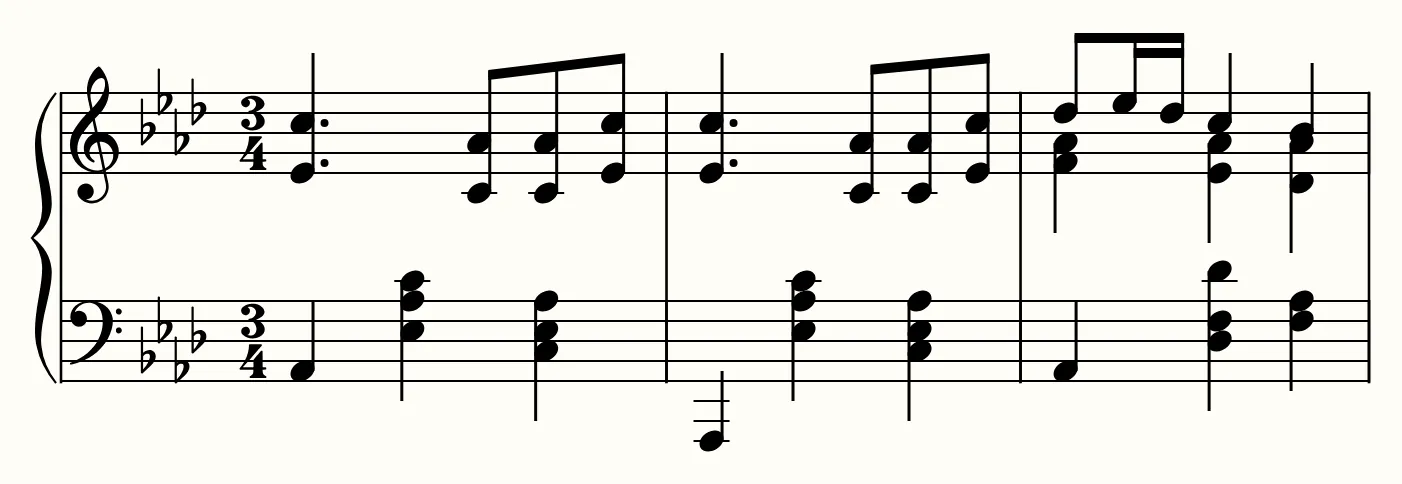
How it links: Brahms (1868)
1880s
Eighty-eight keys
The piano stops growing
By the 1880s the piano had reached the shape we know: seven octaves and a little more, eighty-eight keys from the lowest A to the highest C. Notes much lower or higher are hard for our ears to hear as clear pitches, so the keyboard stopped growing. In 1874 Steinway patented a middle pedal, the sostenuto, which holds only the notes you are already pressing. The piano Beethoven longed for was finally here, and it has barely changed since.
1887
Across the world
From Florence to everywhere
In 1887, in the Japanese town of Hamamatsu, a young man trained in watch repair, Torakusu Yamaha, was asked to mend a broken reed organ. He decided he could build one himself. His company made its first upright piano in 1900. Today most of the world's pianos are made in Asia, and the instrument invented in a Florentine palace is played on every continent.
Test yourself
How many keys does a modern piano have?
- Sixty-one
- Seventy-six
- Eighty-eight
Show the answer
Eighty-eight. Eighty-eight, from the lowest A to the highest C: just over seven octaves.
In the app
The story of the piano lives in Artform’s Theory room: twelve chapters on a road through the years, each one read aloud, with the pieces to play and a tick for every part you finish. Free, in the browser.
Hear chapter VII in the app