Chapter X · Rolls, records and jazz · 1904–1952
Piano rolls, jazz and silence
Ghosts at the keyboard, a new music from New Orleans, and silence.
Painting: Clive Douglas, Haze
Every section is read aloud: press Listen. Or hear the whole chapter in the app, where you can tick off each part as you go.
In this chapter: 1904 Piano rolls · 1915 Jazz is born · 1915 Bartók · 1924 Gershwin · 1952 Four minutes of silence
1904
Piano rolls
Ghosts at the keyboard
Before microphones could record a piano well, inventors found another way. Player pianos read music punched as holes in long rolls of paper. In 1904 the Welte company in Germany went further and built a system that captured how a pianist actually played: every note, and the shape of its loudness. Grieg, Debussy, Mahler and Saint-Saëns all sat down to record rolls. When the rolls are played back today, the keys of a real piano go down on their own, and we can hear, more or less, how Debussy himself played Debussy.
How it links: Debussy (1890)
1915
Jazz is born
New Orleans, and a new way to play
In the dance halls of New Orleans, pianists mixed ragtime with the blues, Caribbean rhythms and church music, and something new was born. Jelly Roll Morton, a brilliant and boastful pianist, claimed to have invented jazz all by himself. He had not, but in 1915 his Original Jelly Roll Blues was one of the very first jazz pieces ever published. Jazz pianists made the left hand stride, leaping between a deep bass note and a chord, while the right hand improvised, so the same tune was never played the same way twice.
How it links: Joplin (1899) · Jazz piano (1959)
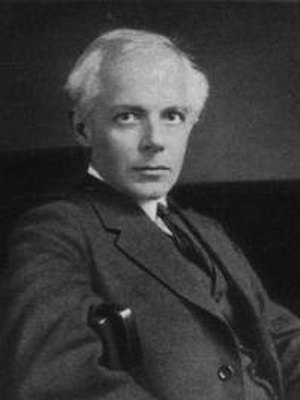
1915 · Béla Bartók, 1881–1945
Bartók
Songs collected from villages
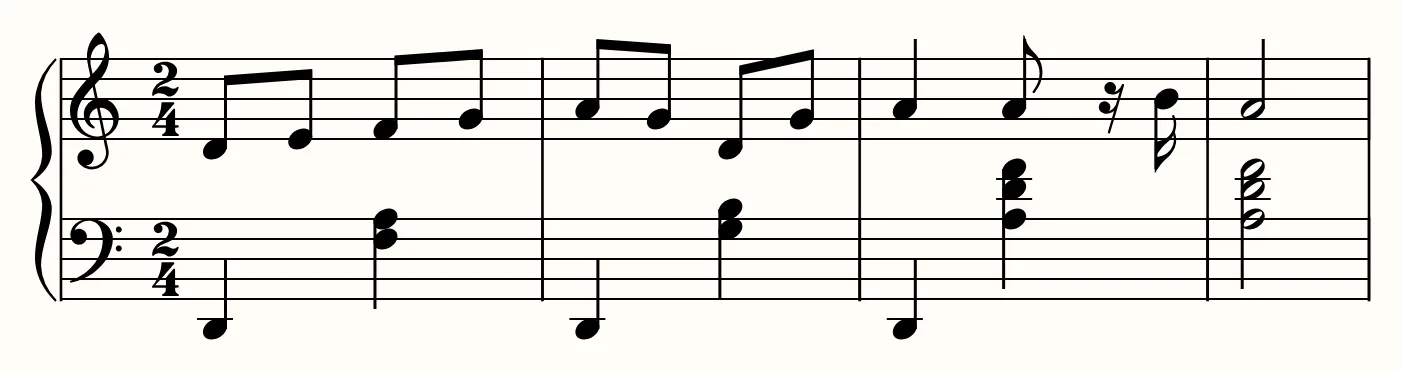
Béla Bartók travelled through the villages of Hungary, Romania and Slovakia with a heavy phonograph, recording country people singing songs nobody had ever written down. He collected thousands. In 1915 he turned some Romanian tunes into a set of short dances for piano, fierce and bright. Bartók played the piano almost like a drum, sharp and rhythmic, and wrote a whole course of pieces, Mikrokosmos, partly to teach his own son. He fled the Nazis to America in 1940, and died there in hardship in 1945, homesick to the end.
1924
Gershwin
A rhapsody heard on a train
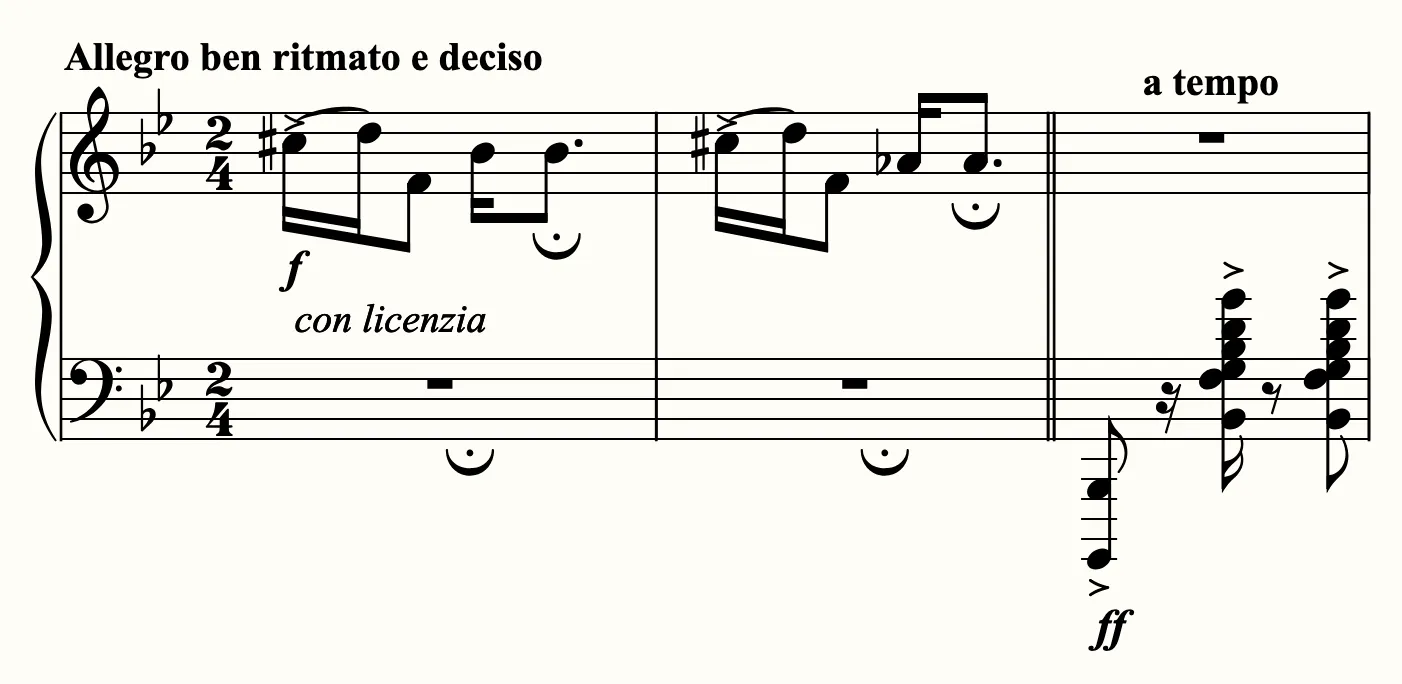
George Gershwin left school at fifteen to be a song plugger, paid to play the latest songs on the piano in a New York music shop. In January 1924 his brother read in a newspaper that George was writing a jazz concerto for a concert just five weeks away. It was news to him. He heard much of it in his head on a train to Boston, in the rattle of the wheels: a musical kaleidoscope of America, he called it. On the twelfth of February 1924 he played the piano part of Rhapsody in Blue himself, improvising some of it on the night. Concert music and jazz had met. He later asked Ravel for lessons, and the story goes that Ravel said: why be a second-rate Ravel when you are a first-rate Gershwin?
How it links: Ravel (1899)
1952
Four minutes of silence
Screws, bolts, and silence
In 1938 John Cage was asked to write music for a dance in a room too small for a percussion band. So he put screws, bolts and pieces of rubber between the strings of a piano and turned it into a whole percussion orchestra: the prepared piano. Then, in 1952, a pianist walked onto a stage, sat at a piano, opened the lid, and played nothing for four minutes and thirty-three seconds. The music was the sound of the room: the audience shifting, the wind and rain outside. Some people were furious. It made the world ask what music really is.
Test yourself
What did a Welte piano roll capture in 1904?
- Only which notes were played
- How a pianist really played, notes and loudness
- The sound of an orchestra
Show the answer
How a pianist really played, notes and loudness. It caught the notes and the shape of their loudness, so a real piano can play them back today.
In the app
The story of the piano lives in Artform’s Theory room: twelve chapters on a road through the years, each one read aloud, with the pieces to play and a tick for every part you finish. Free, in the browser.
Hear chapter X in the app