Chapter XI · Records and electric keys · 1955–1975
Records, jazz piano and electric keys
Bach on record, jazz piano, pop songs and the electric piano.
Painting: Clive Douglas, Lake Victoria
Every section is read aloud: press Listen. Or hear the whole chapter in the app, where you can tick off each part as you go.
In this chapter: 1955 Glenn Gould · 1959 Jazz piano · 1965 The electric piano · 1970 The piano in pop · 1975 The Köln Concert
1955
Glenn Gould
Bach, recorded twice
In June 1955 a twenty-two-year-old Canadian, Glenn Gould, recorded Bach's Goldberg Variations in New York. He sat on a low chair his father had made, hummed as he played, and wore gloves and a scarf in summer. The recording, crisp and dancing, turned a rarely played harpsichord work into a bestseller, and introduced Bach to a whole new generation. In 1981 Gould recorded it again, slower and more inward, as if looking back. It came out in 1982, the year he died, at fifty. Two recordings of the same aria, at the beginning and at the end of a life.
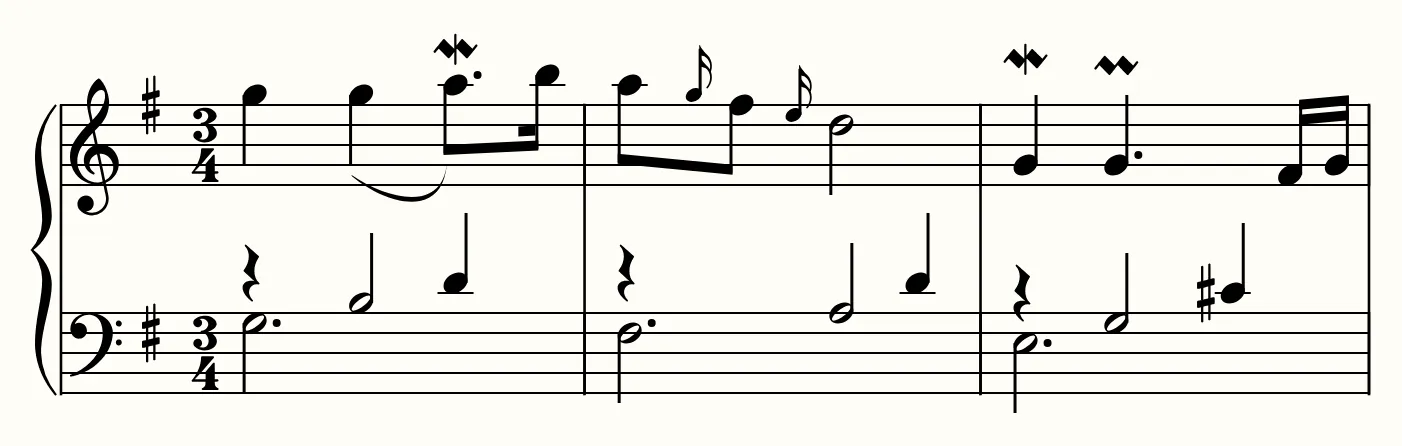
How it links: Bach, in every key (1722)
1959
Jazz piano
Kind of Blue
Jazz piano became an art of its own. Art Tatum played so fast that classical pianists came to listen in disbelief. Thelonious Monk made notes that sound wrong sound exactly right. In 1959 Bill Evans played on Miles Davis's album Kind of Blue, the best-selling jazz record of all time. Evans had studied Debussy and Ravel, and his soft, spacious chords carried their colours straight into jazz. It is one thread: Debussy heard a gamelan in Paris, and seventy years later a jazz pianist in New York heard Debussy.
How it links: Debussy (1890) · Jazz is born (1915)
1965
The electric piano
Electric keys
During the Second World War, Harold Rhodes taught wounded servicemen to play on little pianos he built from the parts of aeroplanes. His ideas became the Fender Rhodes electric piano in 1965, with a warm, bell-like sound that filled soul, jazz and pop records. Bands could finally take a piano on tour without hiring a grand. In the 1980s two more inventions changed everything again: MIDI, a shared language that lets keyboards and computers talk to each other, and digital pianos that could live in any home.
1970
The piano in pop
The piano in the pop song
In the age of rock guitars the piano did not disappear. It moved into the singer's hands. Ray Charles had already brought gospel piano into the blues. Paul McCartney wrote Let It Be at a piano. Elton John and Billy Joel became stars singing from behind a grand, and Freddie Mercury built Bohemian Rhapsody around a piano ballad. Many songwriters still find their songs the same way: alone at a keyboard, looking for the chords.
1975
The Köln Concert
The wrong piano, and a sold-out night
On the twenty-fourth of January 1975, the jazz pianist Keith Jarrett arrived at the Cologne Opera House exhausted and in pain, to find the wrong piano on stage: a small, worn rehearsal instrument with sticking keys and thin top notes. He nearly refused to play. The teenage promoter who had organised the night begged him. He improvised for over an hour, staying in the middle of the keyboard and rolling patterns in the left hand to make the weak piano sing. The recording became one of the best-selling solo piano albums ever made. Sometimes the limits of an instrument make the music.
Test yourself
Which piece did Glenn Gould record at the start and at the end of his career?
- Bach’s Goldberg Variations
- Beethoven’s Moonlight Sonata
- Gershwin’s Rhapsody in Blue
Show the answer
Bach’s Goldberg Variations. Bach’s Goldberg Variations: crisp and dancing in 1955, slow and inward in 1981.
In the app
The story of the piano lives in Artform’s Theory room: twelve chapters on a road through the years, each one read aloud, with the pieces to play and a tick for every part you finish. Free, in the browser.
Hear chapter XI in the app