Beethoven: piano pieces ranked easiest to hardest
The easiest Beethoven pieces to read come first, from the free sheet music library and graded for reading. After them, all 34 play-along chord charts, ranked by chord speed, harmony and tempo.
The easiest Beethoven pieces to read
From the free sheet music library, ordered by how hard each one is to read and play, with the ones people ask for first. Every score plays back at any speed and prints.
- Für EliseIntermediate
- Moonlight SonataUpper intermediate
- Ode to JoyFirst year
- Sonata in G major, Op. 49 No. 2: I. Allegro ma non troppoEarly intermediate
- Sonatina in G (Anh. 5 No. 1)Early intermediate
- Minuet in F MajorEarly intermediate
All the easy Beethoven sheet music · All 116 Beethoven scores
Play along with the chords: all 34, easiest first
- 1.Piano Sonata No. 26 "Les Adieux", 1st movement — Beginner, Eb major, 30 BPM
- 2.Für Elise / Bagatelle für Klavier (a-Moll) WoO 59 — Beginner, A minor, 48 BPM
- 3.Fur Elise Variations Book One — Beginner, A minor, 49 BPM
- 4.Waltz in D Major WoO 85 — Beginner, D major, 50 BPM
- 5.Sonata Op. 31 No. 17 - 3rd Movement - Te — Beginner, D minor, 69 BPM
- 6.Sonatina in G (Anh. 5 No. 1) — Beginner, G major, 80 BPM
- 7.Symphony 7 2nd Movement (Allegretto) Simpl — Beginner, A minor, 80 BPM
- 8.Bagatelle Op.119 N.3 — Beginner, D major, 80 BPM
- 9.Sonatine In F Major WoO Anh. 5 — Beginner, F major, 88 BPM
- 10.Sonatina in F (Anh. 5 No. 2) — Beginner, F major, 100 BPM
- 11.6 Minuets WoO 10 — Beginner, C major, 100 BPM
- 12.Sonatina in G major Ahn. 5 — Beginner, G major, 120 BPM
- 13.Ecossaise in G (WoO 23) — Beginner, G major, 126 BPM
- 14.Sonata in F minor Op.2 No.1 Movement I — Beginner, F minor, 200 BPM
- 15.Symphony No 5 (3rd Movement) Piano solo — Beginner, C minor, 268 BPM
- 16.Symphony No. 6 Pastoral (3rd movement) Pia — Beginner, F major, 288 BPM
- 17.Pathétique, 2nd movement — Intermediate, Ab major, 32 BPM
- 18.Symphony No. 1 (2nd movement) Piano solo — Intermediate, F major, 40 BPM
- 19.Für Elise — Intermediate, A minor, 48 BPM
- 20.Emperor Concerto, Adagio — Intermediate, B major, 48 BPM
- 21.Piano Concerto No. 5 Mvm. 2 (4 hands: Seco — Intermediate, B major, 60 BPM
- 22.Sonata No. 4 Moonlight Sonata (Sonata quasi una Fan — Intermediate, C# minor, 60 BPM
- 23.Six valses (N1/6) — Intermediate, Ab major, 100 BPM
- 24.Symphony No. 4 (4th movement) Piano solo — Intermediate, Bb major, 130 BPM
- 25.Virus — Intermediate, A minor, 180 BPM
- 26.Adagio cantabile — Advanced, Ab major, 31 BPM
- 27.Symphony No. 2 1st Movement (Piano solo) — Advanced, D major, 42 BPM
- 28.Moonlight Sonata (1st mvt) — Advanced, C# minor, 44 BPM
- 29.Piano Concerto No. 5 2nd Movement fragment — Advanced, B major, 48 BPM
- 30.Turkish March - (Arr. by Anton Rubistein) — Advanced, Bb major, 105 BPM
- 31.Symphony No. 5 (4th movement finale) Piano — Advanced, C major, 154 BPM
- 32.Piano Sonata No. 14 Moonlight Sonata III — Advanced, C# minor, 155 BPM
- 33.3rd Mov. Op.27 .2 Sonate .14 Moonlight — Advanced, C# minor, 180 BPM
- 34.Piano Sonata No. 14 3rd Movement — Advanced, C# minor, 188 BPM
Beethoven in the story of the piano
Parts of the history of the piano, the story told in twelve short chapters, from the oldest keyboard music to today. Press Listen to hear it read aloud.
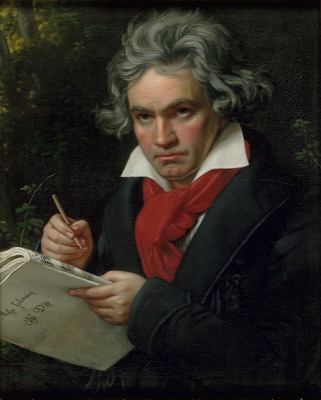
1792 · Ludwig van Beethoven, 1770–1827
Beethoven
Mozart’s spirit from Haydn’s hands
Ludwig van Beethoven grew up in Bonn with a father who drank, and who would drag him out of bed at night to practise. At sixteen he lost his mother, and soon he was looking after his younger brothers. In 1792 he left for Vienna to study with Haydn. A friend wrote in his album: you will receive the spirit of Mozart from the hands of Haydn. Vienna knew him first as a pianist, a wild improviser who could move a room to tears and then laugh at them for crying. He played so hard he broke strings and hammers. The pianos of his day were still light, about five octaves wide. He would spend his life wanting more from them.
From chapter IV of the story of the piano: Beethoven’s piano, 1792–1827
1798 · Ludwig van Beethoven, 1770–1827
The Pathétique
A sonata full of feeling, and a secret
In 1798 Beethoven wrote a dramatic sonata and called it Pathétique, full of feeling. Its slow movement is one of the loveliest melodies ever written for the piano, simple enough to sing. Around this time he noticed a ringing and humming in his ears. For a musician it was the worst thing imaginable, and for years he told almost no one. In 1802 he wrote a letter to his brothers, never sent, confessing how close he had come to despair, and that only his music held him back. He decided to live for his art. Knowing that, listen again to how calm and tender that slow movement is.
From chapter IV of the story of the piano: Beethoven’s piano, 1792–1827
1801 · Ludwig van Beethoven, 1770–1827
Moonlight
Not about the moon at all
In 1801 Beethoven wrote a sonata almost like a fantasy, and dedicated it to Countess Giulietta Guicciardi, a young pupil he had fallen in love with. She married someone else. The first movement floats on slow triplets, and Beethoven asked for the whole movement to be played without dampers. On our pianos that means holding the pedal, so the harmonies blur into each other like mist. The name Moonlight came after his death, from a critic who said it reminded him of moonlight on a Swiss lake. The last movement is the opposite: a storm so fast and so loud that it pushed the pianos of 1801 to breaking point.
From chapter IV of the story of the piano: Beethoven’s piano, 1792–1827
1803
A piano from Paris
Music too big for the piano
In 1803 the Paris firm of Sébastien Érard sent Beethoven a grand piano, bigger and stronger than anything he had owned, with more notes at the top and pedals for the feet. Within months he was writing music that needed all of it: the Waldstein sonata, then the Appassionata, with thunder in the bass and runs to the very top of the keyboard. From here a pattern repeats through this whole story. Composers write music that is too big for the piano, and makers build a piano big enough for the music.
From chapter IV of the story of the piano: Beethoven’s piano, 1792–1827
1810 · Ludwig van Beethoven, 1770–1827
Für Elise
Who was Elise?
On the twenty-seventh of April 1810, Beethoven wrote out a little piece in A minor, for Elise. He never published it. It seems he gave it to Therese Malfatti, a young woman he hoped to marry that very year; she turned him down. The piece was only printed in 1867, forty years after his death, by a scholar who copied it from a manuscript that has since been lost. Nobody knows for sure who Elise was. Perhaps the scholar misread Therese in Beethoven's scrawl. Perhaps it was a singer called Elisabeth. What we do know is that this small, private piece, never meant for a concert, became the most recognised opening on the piano.
From chapter IV of the story of the piano: Beethoven’s piano, 1792–1827
1818
A piano he could not hear
A gift from London
In 1818 the London firm of John Broadwood sent Beethoven a grand piano as a gift, its wood signed by famous pianists. It had six octaves. By now he was almost completely deaf, and visitors wrote their questions in notebooks for him to read. Around this time he wrote his longest and hardest sonata and called it the Hammerklavier, which is simply the German word for piano. In 1824, at the first performance of his Ninth Symphony, he was still beating time when the music ended, and a singer gently turned him round to see the audience on its feet. When he died in 1827, it is said twenty thousand people followed his coffin.
From chapter IV of the story of the piano: Beethoven’s piano, 1792–1827