Schubert: piano pieces ranked easiest to hardest
The easiest Schubert pieces to read come first, from the free sheet music library and graded for reading. After them, all 22 play-along chord charts, ranked by chord speed, harmony and tempo.
The easiest Schubert pieces to read
From the free sheet music library, ordered by how hard each one is to read and play, with the ones people ask for first. Every score plays back at any speed and prints.
- Allegretto in C minor D.915Early intermediate
- Moment musical No. 5 in F minor, D. 780Early intermediate
- Waltz in Bb - D.783 (Op. 33) No. 7Early intermediate
- German Dance in D major, D. 420Early intermediate
- Deutscher Tanz No. 2 in A MajorEarly intermediate
- Waltz in A Minor D.924 (Op. 91a) No. 9Early intermediate
All the easy Schubert sheet music · All 138 Schubert scores
Play along with the chords: all 22, easiest first
- 1.Allegretto in C minor D.915 — Beginner, C minor, 79 BPM
- 2.Valse sentimentale — Beginner, A major, 100 BPM
- 3.Ecossaise No. 4 Op 18 (D.145) — Beginner, G major, 100 BPM
- 4.VALSE SENTIMENTALE Op. 50 No. 13 — Beginner, A major, 100 BPM
- 5.Ecossaise No 2 D.781 — Beginner, D major, 100 BPM
- 6.Minuet in Bâ Major D.41 ( Franz) — Beginner, Bb major, 100 BPM
- 7.German Dance No. 2 in A — Beginner, A major, 120 BPM
- 8.Deutscher Tanz No. 2 in A Major — Beginner, A major, 120 BPM
- 9.German Dance No. 1 (D.420) — Beginner, D major, 174 BPM
- 10.Trio in E flat (2nd mvt) — Intermediate, C minor, 48 BPM
- 11.Der Tod und das Mädchen D.531 — Intermediate, D minor, 54 BPM
- 12.Serenade (Ständchen) — Intermediate, D major, 58 BPM
- 13.XML Swan Song SerenadeD957No4-dminor 01-11-20 — Intermediate, D minor, 76 BPM
- 14.Waltz in A Minor D.924 (Op. 91a) No. 9 — Intermediate, A minor, 100 BPM
- 15.Waltz in Bb - D.783 (Op. 33) No. 7 — Intermediate, Bb major, 116 BPM
- 16.Impromptu Op. 142 No. 2 — Intermediate, Ab major, 120 BPM
- 17.Sonata in A Op.120 D.664 Movement I — Intermediate, A major, 120 BPM
- 18.Piano Trio in E Flat Major 2nd Movement (Pi — Advanced, Eb major, 48 BPM
- 19.'s Serenade Piano Solo — Advanced, F major, 52 BPM
- 20./Liszt - Ständchen — Advanced, D minor, 68 BPM
- 21.Impromptu in C minor n Op. 90 Franz — Advanced, C minor, 85 BPM
- 22.Erlkönig - F. arr. F. Liszt — Advanced, G minor, 152 BPM
Schubert in the story of the piano
A part of the history of the piano, the story told in twelve short chapters, from the oldest keyboard music to today. Press Listen to hear it read aloud.
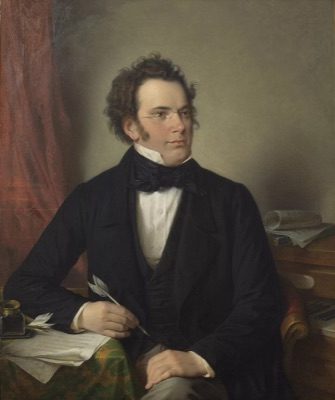
1827 · Franz Schubert, 1797–1828
Schubert
Songs among friends
Franz Schubert never held a proper job and often did not even own a piano. He wrote more than six hundred songs and played them at evenings with his friends in Vienna's living rooms, evenings they called Schubertiads. He was too shy to approach his hero, Beethoven, but in 1827 he walked in Beethoven's funeral procession carrying a torch. That same year he wrote his Impromptus, piano pieces that sing like his songs, a melody floating over rippling notes. The next year he was dead, at thirty-one. Many of his greatest works were not heard until long after. His Ave Maria and his Serenade are songs, but the piano has been singing them ever since.
From chapter V of the story of the piano: The singing piano, 1812–1832