Liszt: piano pieces ranked easiest to hardest
The easiest Liszt pieces to read come first, from the free sheet music library and graded for reading. After them, all 32 play-along chord charts, ranked by chord speed, harmony and tempo.
The easiest Liszt pieces to read
From the free sheet music library, ordered by how hard each one is to read and play. Every score plays back at any speed and prints.
- Nocturne n3 Rêve d'AmourFirst year
- Consolation No. 1 in E major, S. 172Intermediate
- Consolation No. 5 in E major, S. 172Intermediate
- Petite valse favorite, S. 212Upper intermediate
- Consolation No. 4 in D-flat majorUpper intermediate
- Paysage from Transcendental ÉtudesUpper intermediate
Play along with the chords: all 32, easiest first
- 1.Nocturne n3 Rêve d'Amour — Beginner, F major, 40 BPM
- 2.Franz - Consolations I. — Beginner, E major, 100 BPM
- 3.Première Valse oubliée — Beginner, C# major, 255 BPM
- 4.Consolation No.4 in D-flat major — Intermediate, C# major, 48 BPM
- 5.Les Adieux Rêverie from the Opera Romeo and Ju — Intermediate, F major, 61 BPM
- 6.Consolation No. 3 in D Flat Major S 172 — Intermediate, C# major, 65 BPM
- 7.Paysage from Transcendental Études — Advanced, F major, 39 BPM
- 8.Grande Paraphrase de la Marche de Doniz — Advanced, G minor, 58 BPM
- 9.Transcendental Etudes after Paganini No.4 Version II — Advanced, E major, 60 BPM
- 10.Consolation No. 3 — Advanced, Db major, 65 BPM
- 11.Apparitions - No. 3 (Fantasy on a Waltz by Fra — Advanced, E minor, 72 BPM
- 12.Franz : Grandes études de Paganini No.3 in G-sh — Advanced, G# minor, 72 BPM
- 13.Venezia e Napoli I (Revised Version) — Advanced, F# major, 77 BPM
- 14.Hungarian Rhapsody No.6 in D-flat major — Advanced, Db major, 78 BPM
- 15.Transcendental Étude No.11 in D-flat ma — Advanced, C# minor, 80 BPM
- 16.God Save the Queen Paraphrases — Advanced, C major, 88 BPM
- 17.Invocation from 's Harmonies poétiques et relig — Advanced, E major, 88 BPM
- 18.'s Arrangement of Handel's Sarabande and Chacon — Advanced, C minor, 98 BPM
- 19.Gnomenreigen — Advanced, F# major, 100 BPM
- 20.Transcendental Étude No.10 in F minor A — Advanced, F minor, 104 BPM
- 21.Transcendental Étude No.8 in C minor Wi — Advanced, C minor, 107 BPM
- 22.Hungarian Rhapsody No.10 in E major — Advanced, E major, 120 BPM
- 23.Fantasy on Themes from Mozart's Opera The Marr — Advanced, C major, 120 BPM
- 24.Concert Etude in D-flat Waldesrauschen (Forest Murmu — Advanced, C# minor, 120 BPM
- 25.Mazeppa from Transcendental Études — Advanced, D minor, 120 BPM
- 26.Liebestraum No.3 in A-flat major — Advanced, Ab major, 120 BPM
- 27.Franz : Grandes études de Paganini No.6 in A mi — Advanced, A minor, 128 BPM
- 28.Transcendental Étude No.2 in A minor Fu — Advanced, A minor, 144 BPM
- 29.Liebesträume No. 3 — Advanced, Ab major, 144 BPM
- 30.Grandes études No. 4 (Mazeppa) — Advanced, D minor, 150 BPM
- 31.Concert Etude in F-Sharp minor Gnomenreigen (Dance o — Advanced, F# minor, 160 BPM
- 32.Preludio from Transcendental Études — Advanced, C major, 160 BPM
Liszt in the story of the piano
A part of the history of the piano, the story told in twelve short chapters, from the oldest keyboard music to today. Press Listen to hear it read aloud.
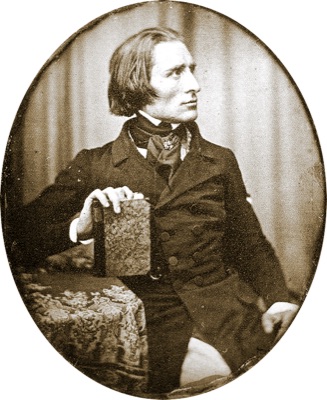
1840 · Franz Liszt, 1811–1886
Liszt
The first piano superstar
As a young man Franz Liszt heard the violinist Paganini and swore to do on the piano what Paganini did on the violin. He practised for hours a day until nothing seemed impossible. In 1840, in London, his concerts were advertised as recitals, and the word stuck: one person, one piano, a whole evening. He played from memory and turned the piano sideways so the audience could see his face. Crowds fought over his gloves; a poet called it Lisztomania. Yet the showman was famously generous. He taught hundreds of students without charging, raised money for Beethoven's monument, and championed young composers all his life. La Campanella is a little bell ringing through some of the most dangerous leaps in all piano music.
From chapter VI of the story of the piano: Poets and virtuosos, 1838–1849