Handel: piano pieces ranked easiest to hardest
The easiest Handel pieces to read come first, from the free sheet music library and graded for reading. After them, all 13 play-along chord charts, ranked by chord speed, harmony and tempo.
The easiest Handel pieces to read
From the free sheet music library, ordered by how hard each one is to read and play. Every score plays back at any speed and prints.
- PassacagliaEarly intermediate
- Minuet (Water Music) HWV 350Early intermediate
- Toccata in G minorEarly intermediate
- Entrée in G minor (Aylesford Pieces)Early intermediate
- Serse, HWV 40: Signor, lasciate far a meEarly intermediate
- He Shall Feed His FlockEarly intermediate
Play along with the chords: all 13, easiest first
- 1.Minuet in G minor (HWV 434) — Beginner, G minor, 60 BPM
- 2.Adagio and Allegro — Beginner, A minor, 65 BPM
- 3.Joy to the World (Piano solo) — Beginner, D major, 72 BPM
- 4.Minuet (Water Music) HWV 350 — Beginner, G minor, 110 BPM
- 5.March from Scipio — Beginner, D major, 110 BPM
- 6.Ombra mai fu (Easy piano edit.) from Opera serse Lar — Intermediate, G major, 52 BPM
- 7.Gigue — Intermediate, F minor, 76 BPM
- 8.Fugue No 1 in G minor HMV 605 — Intermediate, G minor, 116 BPM
- 9.Passacaglia - /Halvorsen (Piano Solo) — Intermediate, A minor, 120 BPM
- 10.Suite II in F major 1- Adagio — Advanced, F major, 30 BPM
- 11.Suite II in F major 2- Allegr — Advanced, F major, 95 BPM
- 12.Passacaille Suite 7 - HWV 432 — Advanced, G minor, 100 BPM
- 13.Suite IV in E minor Gigue — Advanced, E minor, 103 BPM
Handel in the story of the piano
A part of the history of the piano, the story told in twelve short chapters, from the oldest keyboard music to today. Press Listen to hear it read aloud.
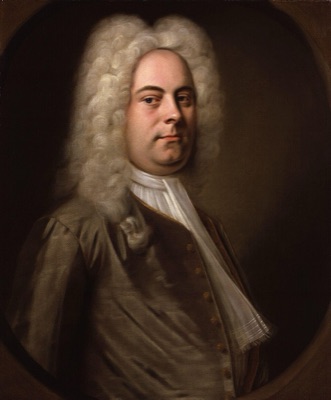
1720 · George Frideric Handel, 1685–1759
Handel
The other giant, born the same year
Handel and Bach were born in the same year, 1685, in towns a few days' ride apart. Bach tried to meet him twice and missed him both times. Bach stayed in Germany. Handel went to London and became a star, writing Italian operas for the English. In 1720 he published eight great suites for the harpsichord. One of them ends with a passacaglia, variations over a bass that keeps returning, with all the drama of a man who wrote for the stage. Handel lost fortunes more than once, when his opera companies failed, and each time he picked himself up and reinvented himself. That restless confidence is in his keyboard music: big gestures, on an instrument that still could not get louder.
From chapter II of the story of the piano: Soft and loud, 1700–1747